Author: Dan Ralley

Springfield City Manager Bryan Heck to Assume OCMA Presidency in July
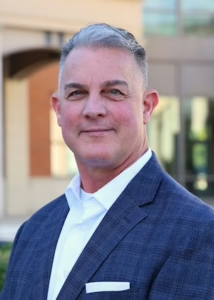
Springfield City Manager Bryan Heck will assume the OCMA Presidency on July 1, 2026. His speech at the OCMA Annual Conference earlier this year overviews his view of local government and the state of the profession.
It is truly an honor to stand before you today as the incoming President of the Ohio City/County Management Association. When you look around this room, what you see is more than just conference attendees. You see decades of experience. You see perseverance and resolve. You see communities across Ohio represented by people who have chosen—deliberately—to serve. That choice matters.
Every one of us could have taken a different career path. I am sure many had options that may have been easier, quieter, and more lucrative. But we chose public service. We chose local government. We chose to work at the level closest to the people. And that is something to be proud of. Local government is where life happens 24/7. Where snow gets plowed at 3:00 a.m. Where a family’s water service gets restored. Where a new business gets its first permit. Where a community gathers after a tragedy. The decisions we make shape daily life in ways that are immediate and tangible. We don’t deal in theories. We deal in trust, accountability, and impact.
Now let’s focus a minute on trust. We are living in a time when trust in public institutions is strained across this country. People are skeptical. They are frustrated. They are watching closely. And yet… local government continues to be one of the most trusted forms of governance. That’s not by accident. That’s because of you. And because of your leadership team and other public servants who serve alongside you every day. Because of the steady way you lead. Because of the professionalism you model. Because you show up — day after day — even when it’s hard. Trust doesn’t happen in headlines. It’s built in budget meetings. In council chambers. In honest conversations with residents. And you build it every single day. It is because of your professionalism. Your integrity. Your steady leadership—especially when the moment is anything but steady.
But also let’s be honest with each other. This profession has changed. The environment we operate in today is different than it was even just ten years ago. The expectations are higher. The pace is faster. The scrutiny is constant. And the amplification power of social media has fundamentally altered how public service feels. A budget decision that once required careful explanation at a meeting can now be summarized in a 10-second clip and shared thousands of times. A personnel decision can turn into online commentary overnight. A misunderstanding can become a narrative before you’ve had a chance to provide context. A total lie about cats and dogs can become viral overnight. And while transparency is important — and accountability is critical — the emotional toll of this environment is real.
Many of us have felt it. The late-night emails, or calls from your Police Chief. The personal attacks. The comments that follow you home. Public service has always required thick skin. But today, it often requires emotional endurance at a level we were never formally trained for. And yet — here you are. Still leading. Still showing up. Still choosing professionalism over politics. That resilience is remarkable. But resilience does not mean isolation.
This is why organizations like OCMA and ICMA matter so much. We are not just members of an association. We are part of a professional community. A support system. A network of people who understand the weight of the job in a way few others can. When you call a colleague in another city to ask how they handled a major challenge… When you reach out for advice about a difficult council relationship… When you ask someone, “Have you ever dealt with this before?” That is OCMA at work. This association exists not only to advance the profession — but to sustain the professionals.
And sustaining the professionals must include something we have not talked about enough in our field: mental health and well-being. If I could emphasize one priority during my time as President, it is this. We need to protect the people who protect our communities. The expectations placed on city managers, county administrators, township administrators, and the teams we lead are extraordinary. We are asked to be financially disciplined, politically neutral, emotionally intelligent, operationally excellent, and constantly available. We manage crises. We absorb conflict. We mediate disputes. We carry institutional memory. And we often do so without a space to process the emotional impact of that work.
Burnout in our profession is not hypothetical. It is real. Anxiety. Chronic stress. Fatigue. The subtle erosion of work-life boundaries. For years, many of us were conditioned to believe that endurance was the standard. That long hours equaled commitment. That exhaustion meant we were doing it right. But that model is not sustainable. If we want talented young professionals to enter this field — and stay in this field — we must create a culture where well-being is not an afterthought. Taking care of your mental health is not a lack of toughness. Setting boundaries does not signal a lack of dedication. Seeking support does not undermine your credibility. In fact, it strengthens it. A clear mind makes better decisions. A healthy leader builds healthier organizations. A supported professional sustains a longer career.
During my presidency, I want OCMA to continue advancing conversations and resources around mental health. That means education. It means peer support. It means sharing best practices not only for operational excellence — but for personal sustainability. It also means we check on each other. If a colleague seems overwhelmed — reach out. If someone withdraws on your team — notice. If you are struggling — speak up. We are excellent at solving community problems. We must become equally intentional about supporting one another. Because the future of local government depends on people who are not just capable — but whole.
And here is the good news. Despite the challenges… despite the pressure… despite the changing environment… I am incredibly optimistic about our profession. I see innovation happening across Ohio. I see collaboration between local governments and the professionals who lead them. I see emerging leaders bringing fresh ideas. I see seasoned professionals mentoring the next generation. We are evolving — and we are doing so with integrity. Public service is still one of the most meaningful callings available. Few professions allow you to look at a neighborhood, a park, a thriving downtown, or a balanced budget and say, “I helped make that happen.” That is impact. And it is impact that lasts far beyond any single news cycle or social media post.
As we leave this conference and return to our communities, we will step back into full inboxes, complex challenges, and difficult conversations. That is the nature of this work. But I hope you leave here reminded of something important. You are not alone. You are part of a profession grounded in integrity. You are part of a network that supports one another. And you are part of a calling that still matters deeply. Public service is not easy. It never has been. But it is meaningful. It is impactful. And when done well, it changes lives — often in quiet ways that history will never record, but families and communities will always feel.
So lead with courage. Support one another. Protect your well-being. And never lose sight of why you chose this path in the first place. Because at the end of the day, the work we do strengthens communities — and strong communities strengthen our state. It is an honor to serve alongside all of you and I look forward to the work we will do together.
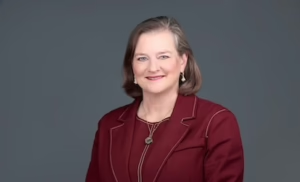
Julia Novak: State of Our Profession
The following is a transcript of ICMA Executive Director Julia Novak’s speech at the OCMA Annual Conference on February 27, 2026.
Good morning, friends and colleagues. I appreciate the invitation to be with you today – attending a State Association Conference where there are no airplanes, long drives and hotels involved is pretty special.
I’m also pleased to share with you my take on the state of our profession. I began writing this at a time when Springfield, Ohio was bracing for a wave of immigration enforcement on their Haitian residents, while also planning for next year’s Annual Conference in Long Beach, our Global Exchange in Ireland, and our Local Government Reimagined Conferences on AI and Democracy and Public Trust, members in other areas dealing with the stress of an uninvited Federal Police presence in real time, and I kept going back to 11th Grade English and Dickens A Tale of Two Cities – It was the Best of Times, it was the Worst of Times, and I was remembering a water bottle sticker on one of my Board Members water bottles at our January meeting – it said “Both Things Can Be True.”
For us, for the state of the profession, I believe:
It is the best of times; and
It is the worst of times; and
If that feels uncomfortably accurate to you right now—that’s because both things can be true.
Over this past year, Bob O’Neill, Kendra Stewart, John Nalbandian and I have been working on some research – research that built on original work from 2017 that became known as Disruptive Trends.
What people told us was that this moment feels harder, more political, more personal.
Let me start where we usually don’t.
This is the worst of times when:
The problems we face are more complex, more interconnected, and more political than ever—yet the margin for error has never been thinner.
Our research confirmed that the most impactful forces facing local government today are not abstract, they include:
• Politicalization and Polarization
o Impact of federal and state policies
o More elected officials with entrenched views
o No shared understanding of the “common good”
o People identify with those who agree with them, not necessarily those in their city/county – finding community in online echo chambers instead of in neighborhoods
• The Changing View of Institutions
o Less public trust in government
o Less elected official trust in staff
o Less civility in discourse
o Blurred boundaries between the role of staff vs. elected officials
• Technology – Social Media, AI
• Fiscal pressures
• State preemption
• Workforce challenges
• The pressure of responding to the impact of extreme weather – Climate Change
What we heard is that these forces are colliding—not sequentially, but simultaneously.
When Bob and John engaged in the original research, former City Manager Jim Keene shared this observation:
“Disruption connotes an unexpected discontinuity of some magnitude. Disruptions are inevitable. But reconciliation—positively reacting to disruption—is not inevitable. It takes intent.”
Disruption is inevitable – Reconciliation – repair – MUST be intentional.
That intent is where you come in, that intent is what’s being tested.
This is the worst of times when everything is urgent, but nothing is simple.
When housing shortages make it harder to recruit firefighters, engineers, and planners—and yet every housing conversation becomes a proxy war about identity, ideology, and control.
When local control is questioned or constrained, even as residents still expect their city hall to fix what’s broken.
I mean – your communities will all be fine if they do away with property taxes in Ohio, right? (That’s Sarcasm Sheldon…)
When technology moves faster than policy—when AI can streamline purchasing and speed plan review in one breath, and in the next raises legitimate concerns about water, land use, ethics, and equity.
And when trust—once assumed—now feels conditional.
As one former Ohio manager told us:
“Facts no longer matter. Polarized council members use non-factual sound bites as weapons—against each other and against staff. The result is growing distrust of professional local government and an increasing challenge to attract and retain talent.”
This is the worst of times when civility erodes, boundaries blur, and professional expertise is questioned—not occasionally, but routinely.
And it is the worst of times when you—the professional local government manager—are expected to absorb all of it.
To be neutral, but decisive.
Invisible, but accountable.
Empathetic, but unflinching.
To “just take it.”
That weight deserves to be named.
And Yet…
As Dickens reminds us—the story doesn’t end there.
Because this is also—the best of times.
It is the best of times because local government still works.
Despite everything:
• Services are delivered
• Emergencies are managed
• Communities function
Not because conditions are easy—but because professionals show up.
Our research shows that even as pressures increase, the role of the manager is not shrinking—it is expanding.
Managers told us they are increasingly called to fulfill a new role.
Tansy Hayward, City Manager of Thornton, Colorado noted:
“Managers are increasingly called to convene community-based conversations on social issues that intersect the public, nonprofit, and private sectors.”
You are more public-facing.
More scrutinized.
More political.
But also—more essential.
This is the best of times because your teams are evolving to meet the moment under your leadership.
Assistants and department heads are becoming more enterprise-minded, more collaborative, and more strategically engaged—so managers can focus on what only they can do.
As one respondent put it:
“Being a subject-matter expert is no longer enough (for department directors). Leaders must think big picture, connect the dots, and take an interdisciplinary approach.”
That is adaptation, that is resilience, and that takes professional courage.
Here is the paradox the data reveals:
As trust in institutions declines, expectations of local government increase.
As politics becomes more polarized, managers are asked to be more politically savvy.
As elected officials face louder pressure, staff absorb the impact.
Managers told us expectations are higher than ever—often without a clear understanding of what is feasible.
As a consultant I would begin almost every workshop with elected officials by acknowledging what gets DONE by your local governments sits at the intersection of political acceptability (what there is the WILL to do) AND administrative sustainability (what there is the organizational CAPACITY to accomplish).
You are asked to support employee wellness (physical and emotional), maintain performance, navigate blurred boundaries, and still deliver results.
You operate where democracy meets plumbing.
Where ideals meet invoices.
Where values meet deadlines.
You are not just managing organizations.
You are holding the center.
Now here is where this moment shifts—from burden to opportunity.
Because this year, in 2026, our country marks 250 years of representative democracy.
And that experiment does not live in Washington DC or on Cable News.
It lives locally.
In council chambers.
In public meetings.
At peaceful demonstrations.
In how decisions are made—and explained.
The real question is not whether democracy is under strain.
It is this:
What does professional local government look like when democracy is under strain?
What is the value proposition of this profession?
Your peers answered that, too.
High-performing organizations right now are anchored by:
• Trust
• Clear communication
• Alignment between mission and daily work
• Support for staff
• Ethical leadership
As one manager described it:
“High performance comes from disciplined alignment—from council priorities to individual work—so every employee understands how their work contributes to community outcomes.”
That is competence with integrity.
Innovation with ethics.
Efficiency with humanity.
So here is my charge to you—grounded in the reality of your community, with your voices, and your lived experience.
Keep telling the truth—calmly, clearly, relentlessly.
Keep building systems that work even when politics don’t.
Keep mentoring the next generation—because workforce challenges are real, but purpose still attracts people to this work.
Keep modeling leadership when no one is clapping.
And when you wonder—quietly, late at night—
“Why would anyone do this?”
Remember the answer.
Because local government is where democracy becomes real.
Because communities don’t run on slogans—they run on service.
Because when trust is fragile, professionalism becomes the anchor.
Both things can be true…
Coalition Forms to Help Educate on Property Taxes
A public education effort is underway by Ohioans to Protect Public Services, a statewide coalition that includes the Ohio Municipal League along with more than 65 partner organizations.
The coalition came together in response to an effort to place a constitutional amendment on the November ballot that seeks to abolish property taxes in Ohio. View the news release that was issued here.
While the status of the amendment remains uncertain – as its backers are currently working to collect the signatures necessary to place it on the ballot – this effort underscores the importance of educating Ohioans so they can understand what is at stake.
Ohioans to Protect Public Services is focused on educating the public about the impact of eliminating Ohio’s property tax, including:
- The critical role property taxes play in funding local services
- How these revenues are used in communities across Ohio
- The potential consequences to public services if property taxes were eliminated
The coalition publicly released a suite of resources and tools to support this educational effort, including a website, informational video, one-pagers, social media content, and more. Municipalities may specifically be interested in the resolution template and useful links to use and share. Be sure to check out the website to see everything that has been made publicly available.
The coalition website can be viewed at ProtectPublicServices.org.