Skip to content Skip to main navigation Skip to footer

News

Lebanon Building $14.1 Solar Array on City Land

Lebanon has cleared the latest hurdle toward building a $14.1 million solar array on undevelopable city-owned land, aiming to diversify its sources of electricity and provide savings for the city, its residents and businesses.

The Lebanon Planning Commission on Tuesday held a public hearing and voted to approve a request by the city and its consultant, Kokosing Solar, for a conditional use permit to construct three solar arrays on 37 acres of city property in the floodplain near the Glosser Road substation.

Read more

Need Help? Technical Assistance for Thriving Communities

by Tad McGalliard | Jul 01, 2023 | PM MAGAZINE – ARTICLE

With the expansion of existing federal funding initiatives and the development of new programs resulting from the Bipartisan Infrastructure Law, and planned investments in clean energy and climate resiliency from the Inflation Reduction Act, many federal agencies have established technical assistance centers to support cities, counties, towns, and townships, especially those that have not traditionally received federal funding. Most of this assistance is available without a fee or requirements for a lengthy consulting contract or procurement process.

Typically, the programs identified in this article will follow a similar process of intake through an online form or referral from the federal agency; an onsite and/or virtual assessment of key challenges and needs; a longer-term engagement of activities targeting a priority need; and wraparound services and follow-up to help ensure that the targeted outcomes are achieved.

Environmental Finance Centers

The EFC program has been around for a number of years, but recent funding has led to an increased number of centers focused on supporting community projects in areas like drinking water, wastewater, and stormwater infrastructure. Other focal points include local infrastructure investments in solid waste, clean air, greenhouse gas reduction, and toxic substance management. In late 2022, the Environmental Protection Agency (EPA) announced 29 new EFCs that will be operated by universities and nonprofit organizations. ICMA is a partner with the Low Impact Development Center (LIDC), which will support communities in EPA’s Region 3, which includes the states of Pennsylvania, Delaware, Maryland, West Virginia, Virginia, and the District of Columbia. Learn more at epa.gov/waterfinancecenter/efcn.

Technical Assistance for Brownfields

Since the mid-1990s, EPA has awarded grants to local governments and community organizations to assess and clean up brownfields, in addition to setting up revolving loan funds and conducting area wide planning. EPA funds several organizations (including ICMA, see icmatab.org) to provide support to communities, tribes, and nonprofit organizations on their brownfield challenges. 

Hilliard City Staff Serve As Innovation Ambassadors To Solve Problems

When a local business owner heard the City of Hilliard’s slogan, “Real People, Real Possibilities”, he knew he had come to the right place to test his new coffee product.

Steve Johnson’s company, Off The Beaten Path, has been brewing coffee and tea for six years. The beverages are cold-brewed over a period of time to not bring out bitterness or lower caffeine content, and then infused with Nitrogen gas to create flavor profiles without drinkers needing to add creams and sweeteners.

Now, the business is taking the next step in getting its product to market with the help of City of Hilliard staff members who are promoting innovation and economic development through Hilliard City Lab.

And City of Hilliard staff members also were happy to be taste testers in their role as Hilliard City Lab Innovation Ambassadors.

Hilliard City Lab began in 2022 as a partnership between the City of Hilliard and Converge Technologies, a technology incubator. In short, Hilliard City Lab turns the entire Hilliard community into a real-world lab where start-up technology firms and other companies can test and launch their products into commercialization. The City of Hilliard provides access to its infrastructure, expertise, data, existing technology, and funding opportunities. There are already eight companies in the Converge Technologies space developing drones, tracking devices, radar systems, software, large-scale 3D printing processes, and more.

The success of this partnership inspired the City to create a working group of staff members who could serve as Innovation Ambassadors, identifying potential challenges and opportunities that Hilliard City Lab partners and processes could solve and benefit from.

The group of about 20 staff members meet monthly to brainstorm innovative ideas to improve City processes. Those ideas are taken to Hilliard City Lab businesses – another way the City becomes a testbed for new technologies.

In return, the goal is that Hilliard will benefit from the attraction, retention, and expansion of technology businesses, along with the creation of associated high-paying jobs.

Hilliard City Manager Michelle Crandall, who developed the program, said she has been pleased with the staff’s response.

“These are people who have ideas on how to deliver City services more efficiently and need the opportunity to share those ideas,” said Crandall. “It also allows them to take a break from their everyday tasks and think more creatively.”

Several ideas are already in motion.

  • Ubihere, one of the companies, is working with the City’s Operation Department to develop sewer sensor technology. The goal is for a sensor to notify the City when the water level is increasing on the sewer system, triggering a response from the City before basements are flooded.
  • Recently, the City tested an “Americans With Disabilities Act compliance cart” developed by Converge, which pedestrians push along sidewalks to locate spots that would be difficult to traverse in a wheelchair. When the cart hits a bump, it automatically takes a geo-tagged picture of the sidewalk and uploads it to the Internet for review and possible repair. The cart was tested by members of the Hilliard Senior Center on their everyday neighborhood walks.
  • Lighthouse Avionics is working with the Division of Police to develop a drone for first responders to survey crash sites or crime scenes before police officers arrive on scene. To guide the drones, Lighthouse is also developing “virtual control towers” — collections of camera sensors that can track flying objects up to three miles away.
  • IC3D, a 3D printing company, is working with City’s Recreation and Parks staff to design benches and tree gates to replace metal structures that quickly rust under weather conditions.

Anastasia Bradley, the City’s Aquatics Supervisor, is one of the ambassadors.

“There are a lot of problems to solve in my position, so having the ability to work with people who might have better ideas is cool,” she said. “And, it’s nice to see the behind-the-scenes work of projects I’m not directly involved in, like the tree gates. It creates a community within a community.”

Andrew Wilson, the City’s Geographic Information Systems (GIS) Administrator, thought of several projects to tackle during a recent tour of the Hilliard City Lab.

“It’s rare in government to have an innovation program that combines City staff with the private sector,” he said. “Combining ideas and skills leads to better solutions, engineering value, and an overall bang for the buck for taxpayers.”


Internships as Immersive Learning Experiences in Centerville

The City of Centerville recently revamped its internship program, configuring its summers as immersive learning experiences for as many as a dozen undergraduate students each year.

“This is a mutually beneficial experience: our students spend 40 hours a week learning one-on-one with experts in their chosen fields and the city emerges stronger and more efficient because of their work,” City Manager Wayne Davis said.

In the summer of 2022, for example, Centerville hosted ten interns across nine departments ranging from civil engineering and communications to economic development and finance. Students represented schools from Ohio, Indiana and South Carolina.

Davis engineered the overhaul of the program, which continues to evolve with the support of City Council.

“Many organizations talk about work like this, but they never achieve maximum results. It takes time. It takes effort. We are fortunate to have a team willing to make that commitment, as well as the support of City Council,” Davis said.

Kileigh Lade, a West Virginia University graduate, was a Development Department intern in 2021. She now works as a landscape designer at Kiser + Vogrin Design, a landscape architecture firm outside of Nashville Tennessee.

“My experiences in Centerville ranged from creating wall diagrams for mural artists to building a comprehensive business database. I am grateful for the months I spent there as an intern, which offered me lifelong relationships and prepared me well for my professional career,” Lade said.

She points to interacting with prospective business owners as another highlight of her internship.

“I was trusted with the freedom to pursue projects that aligned with my passions, provided they also aligned with the city’s values and strategic plan,” Lade said.

Intern Michael Berner spent the summer working out communications details of an electric and gas aggregation program, coordinating with performers of the Summer Concert Series at Stubbs Park and improving a children’s activity book.

“I coordinated with all departments across the city to make sure the information was updated, accurate and age-appropriate for the many groups of children who tour city building each year.”

Berner is now bound for law school at the University of Dayton.

Other significant intern projects have included a significant value to residents and businesses in Centerville:

  • Clerk of Council interns took on the mammoth task of inventorying, assessing for retention and recommending dispositions for an estimated 180,000+ pages of documents.
  • Interns assisted with the reconciliation of income tax returns and also helped audit businesses in Centerville to determine appropriate filing status. 
  • A Benham’s Grove intern created a digital floorplan application that enhances customer service by allowing faster and more flexible event set-up, as well as a more accurate plan for the day of the event.
  • A public works intern worked with waste truck drivers’ route maps to determine which route every container is on and create a comprehensive spreadsheet. This allows staff to replace containers based on routes and creates a more efficient way of replacing containers.
  • An engineering intern established a ditch inspection program by creating an inventory, charting out all the ditches in the city and helping to develop the inspection procedures.
  • An economic development intern prepared a contact list for a business walk, an opportunity for staff to walk commercial areas and chat first-hand with business owners about challenges they may face. This work included research on the history of each business.

The city says the value of the work generated by interns each summer far exceeds the cost to the city.

Each intern tours all city buildings, attends a Career Next Steps workshop, has the opportunity to shadow the city manager and assistant manager and attends relevant local and regional events.

2023 interns will converge in Centerville from universities in Ohio, Kentucky, North Carolina and Florida. The group of ten will also join in a summer-long public service project. Recycle Right is a Centerville program run every two years designed to reduce the amount of recycling contamination. Interns will be integral to the pre-sorting process with Rumpke, getting a baseline contamination figure. They will spend time across four weeks surveying recycling toters and offering feedback to staff and residents on whether communication efforts are working and people are recycling appropriately.

“These unique, meaningful experiences prepare our next generation of leaders for the workforce – whether that be in public service or the private sector,” Davis said. “We are both stronger for these experiences.”

Former Chief Justice O’Connor Speaks to OCMA Conference Attendees

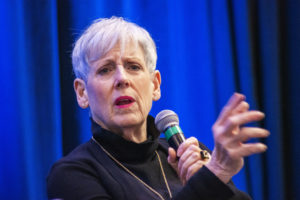
Former Chief Justice of the Ohio Supreme Court, Maureen O’Connor, delivered a speech on April 6th to the Ohio City County Management Association at OCMA’s Annual Conference that highlighted the importance of effective leadership and the role of the law in promoting fairness and justice in our communities.  

According to O’Connor, working in government is about “solving problems for people who can’t solve them themselves.  I have always wanted to use our system of government to solve problems.  Use the system to make it better.”  O’Connor stressed that good leadership requires a willingness to listen to different perspectives and to engage in constructive dialogue with those who may hold opposing views.  “Weave kindness into how you do your job,” O’Connor encouraged attendees. 

Drawing on her extensive experience in the legal profession, O’Connor provided valuable insights into the challenges facing local governments and noted that the administration of the law is not something that is partisan.  Referencing the controversy of redistricting that she was at the center of during her tenure on the Ohio Supreme Court, O’Connor noted that she is working on a constitutional amendment for the November 2024 ballot that would depoliticize the redistricting process.  “Redistributing reform is crucial to our democracy.   When you have a monopoly you don’t tend to represent all of people.”

The former Chief Justice also encouraged conference attendees to talk to kids about local government in order to expose children to important concepts in our democracy, such as the fact that “we are one of many”. For those interested in working in local government and getting into public service she urged “don’t be afraid to raise your hand and say I’ll do it”.  

Starting Simple in Performance Management

By By Raman A. Shah, Ph.D. from ICMA Blog

“We should measure impact, not output.”

Across the public and nonprofit sectors, every time I’ve suggested implementing operational reporting as a management tool, I’ve heard this rebuttal. I doubt I’ve ever waited more than 15 seconds to hear it. In local government, this mostly comes up in relation to strategic planning—writing a new strategic plan or tracking progress toward an existing one.

Output looks inward, at operations. As an example of output measurement, a city may count the feet of bicycle lanes it builds. Impact looks outward, at society. As an example of impact measurement, the city may track the growth in bicycle ridership.

It’s common sense that impact is what ultimately matters; a badly routed bicycle lane might be worthless. Unfortunately, impact is slow to appear and hard to measure. It depends on the same messy internal data that powers output measurement. I’ve found that measuring output with precision and regularity is practically a prerequisite to trustworthy impact measurement.

Impact measurement is slow

Impact can be slow to appear because services can take a long time to soak in and change lives. A bicycle lane might take years to achieve full impact as residents’ habits and possessions evolve to use it. That’s in addition to the time needed for analysis, so the lead time for impact measurement is generally long regardless of the tools at your disposal.

Contrast this with counting the feet of bicycle lane. Perhaps two construction companies are working on bicycle lanes, and you find that one is moving three times faster than the other. Is the faster vendor cutting corners, or is it more efficient? (Both? Neither?) Following up could deliver vital value for residents, days or weeks after work commences—if good output measurement infrastructure is in place.

Impact measurement is hard

In the meetings where it’s suggested to measure impact and not output, the idea is to run a survey before and after service delivery. The change in the results is the impact. Easy, right?

This doesn’t work because the world changes and doesn’t look the same everywhere.

If the world were perfectly static, the simple survey idea could work. But sometimes a professional cyclist becomes a national hero, and everyone buys a bicycle; sometimes they fall into scandal, and the bicycles start collecting dust.

Unlocking Opportunity: Ohio’s Brownfield Remediation Fund Awards & The Benefit of Brownfields

The Greater Ohio Policy Center (GOPC) has released Unlocking Opportunity: Ohio’s Brownfield Remediation Fund Awards & The Benefit of Brownfields. This white paper examines the $341 million awarded through all three rounds of the Brownfield Remediation Fund. The white paper also makes the case for allocating another $500 million to the program in the next state Operating Budget. 

Passed in the FY22-23 Main Operating Budget, the Brownfield Remediation Fund (BRF) invested $341 million in environmental cleanup through grants awarded in 2022. Projects are underway to assess, cleanup, and revitalize brownfields in 83 of Ohio’s 88 counties.

Alison Goebel, Executive Director, said, “We commend the Ohio Legislature for making the most significant investment in brownfields in nearly a decade, and look forward to the economic impact these projects will have for Ohio’s communities.” 

In total, the Brownfield Remediation Fund granted $341 million to 313 projects. Eighty-three of Ohio’s 88 counties were awarded grant dollars for 188 clean-up projects and 125 assessments. In total, nearly 98% of Ohio’s population resides within counties that received grant awards. 

Aaron Clapper, Senior Manager of Outreach and Projects, and author of the white paper said, “The anticipated end uses for the remediated sites are impressive. We are excited about the mixed-use, affordable housing, transit, and new industrial sites that communities are planning for these cleaned sites.” 

Making the Leap from ACAO to CAO

By Jeff Wechbach, Colerain Township Township Administrator. Originally published in PM Magazine
It’s 2pm on a Friday before a holiday weekend. You are at a local chamber of commerce event when your boss, the chief administrative officer (CAO), pulls you aside for a walk and talk. Your head starts to sift through the various personnel issues and complaints that the community is dealing with, thinking that this talk is going to somehow be related to one of those items. Instead, you are hit with a curve ball as you quickly learn that your boss has taken a job in the private sector and their last day is less than a month away.

I wish I could say that the coming months would be easy. In my case, I was the only assistant chief administrative officer (ACAO) for our community. My contract with our elected board stated that I would be appointed as the interim administrator in the event of a vacancy in the CAO role. Thankfully that meant that I had the clarity to know I would be an interim for some time while our elected board determined a course of action. However, I still had to figure out if I would want to apply for the CAO role, and if so, what would I do differently? How would I manage the work in the interim capacity knowing that there are only so many hours in the day?

As I sit here today, I am fortunate to have been promoted to the CAO role and found excellent individuals to serve as the ACAO for my organization. However, as I reflect on the past several months, I realize that I learned a lot during the transition. While all of these points may not translate to every transition, some of these might be helpful to someone who is just having an unexpected walk and talk.

1. Strengthen Your Relationship with Department Directors

First and foremost, work to earn the respect of department directors now. If you haven’t spent a great deal of time working directly with your department directors or if you have some friction with them, use the time as the ACAO to mend fences and build connections. Elected officials are going to call the other members of the leadership team to get their perspective on your abilities, and their opinion will influence the decision on hiring you as the CAO.

Ohio Using Quality of Life As Economic Development Tool

A growing handful of Midwestern cities, like Columbus, Ohio, Traverse City, Michigan, and Carmel, Indiana, are reaching beyond traditional incentives for recruiting business and industry, focusing on how to expand their populations by promoting the region as a good place to live.

“This is probably the fastest-growing innovation in economic development for 50 years,” said economist Michael Hicks, a professor at Ball State University in Muncie, Indiana, where he runs the Center for Business and Economic Research

The county in Indiana with the strongest population growth—Hamilton—for instance, is “almost exclusively trying to attract people,” Hicks said. With four mid-sized cities, including Carmel, the county’s 350,000-plus population has a median household income of around $100,000 and officials are projecting consistent job gains over the next five years. The county and its cities consistently make “best places to live” lists because of the quality of public schools, amenities for singles, the health of the population and opportunities for outdoor recreation.

Parts of the Midwest served as longtime anchors for U.S. manufacturing, but saw declines in recent decades as jobs moved overseas or to Southern states where companies see factors like fewer labor unions, lower taxes and cheaper land as upsides. Meanwhile, coastal cities like Boston, San Francisco and Seattle served as magnets for firms and talent in the tech sector. 

The emerging focus on attracting people who can provide the foundation for a solid workforce in the region stands in contrast to other approaches to economic development, which can often prioritize policies like tax breaks for companies to build factories or warehouses.

But as economics professor Amanda Weinstein of the University of Akron’s College of Business, in Ohio, noted, “We are increasingly seeing the jobs move to people rather than the people move to jobs.”

The rise of remote work adds another twist, allowing professionals in some fields to work anywhere and giving communities across the country a chance to lure them in.

Weinstein, like some other economists, advises local governments to invest in and promote quality-of-life amenities, along with health care and education, to help retain residents and attract out-of-staters looking to relocate to affordable, family-friendly communities.

City Health Dashboard Provides Data and Insights Into Community Health

A partnership between New York University and the Robert Wood Johnson Foundation is providing new insights into community health data in cities and states across the country. The City Health Dashboard aims to make neighborhood level data easily accessible to drive action to improve the nation’s health.

Communities can find it difficult to access data at the census track or city level. The City Health Dashboard aims to simplify and streamline this process to identify health outcomes including the current physical and mental health of a community, and health factors that are driving outcomes in the physical environment. Metrics include social and economic factors, health behaviors and access to medical care.

This data has also been used to evaluate gun violence as a public health crisis, which has been increasing in recent years. In partnership with Everytown for Gun Safety Support Fund, the City Health Dashboard has added new metrics to demonstrate the impact that guns are having on communities: firearm homicides and firearm suicides. These measures mark the first time that CDC-collected death records have been analyzed to the city level for hundreds of cities across the country. Among the findings, the data has shown that four out of every ten gun-related deaths in cities nationally were suicides, an 11 percent increase since 2014. City leaders can move communities in the right direction, and these data can be the first step. Explore new gun violence data for your city on the dashboard.